Fusing IMU Sensor Data From MPU6050 Using I²C on Arduino for Orientation Tracking
Connect your MPU6050 to Arduino using short I²C wires-VCC to 5V, GND to GND, SCL to A5, SDA to A4-with AD0 grounded for address 0x68. Calibrate with 200 static samples to fix gyro bias, applying offsets like -2.18°/s to stop drift. Fuse sensor data using a 96% gyroscope, 4% accelerometer complementary filter for responsive, stable roll and pitch. Tight wiring, 4.7 kΩ pull-ups, and clean 3.3V signals keep fusion accurate over time, giving reliable orientation you can build on.
We are supported by our audience. When you purchase through links on our site, we may earn an affiliate commission, at no extra cost for you. Learn more. Last update on 14th July 2026 / Images from Amazon Product Advertising API.
Notable Insights
- Connect MPU6050 to Arduino via I²C with SDA on A4 and SCL on A5, using 4.7 kΩ pull-ups for stable 3.3V signals.
- Wake the MPU6050 by initializing I2C and writing 0x00 to register 0x6B to enable sensor readings.
- Calibrate gyroscope and accelerometer by averaging 200 stationary samples to compute and apply bias offsets.
- Use a complementary filter blending 96% gyroscope data and 4% accelerometer data to compute stable roll and pitch angles.
- Accelerometer corrects gyroscope drift in roll and pitch; yaw remains uncorrected and drifts over time.
Wire MPU6050 to Arduino for Reliable I²C Communication
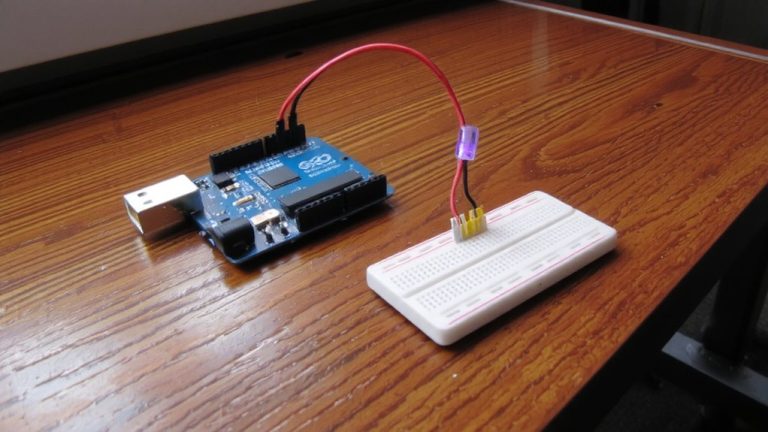
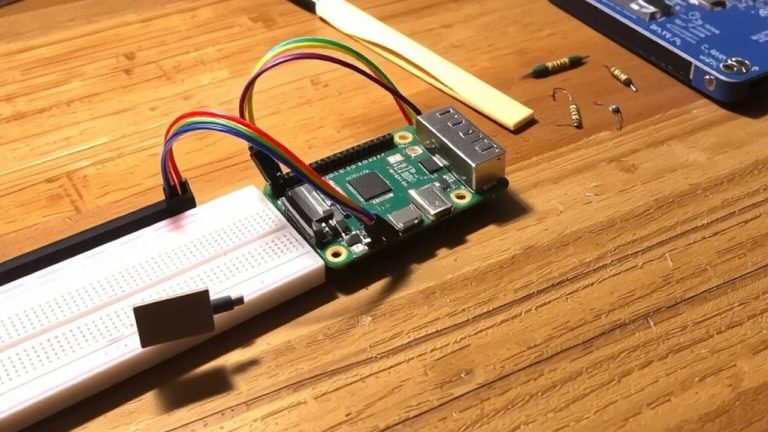
Your MPU6050’s onboard pull-up resistors save you a few wires, but for rock-solid I²C performance, it’s smart to verify they’re 4.7 kΩ-most GY-521 modules include them, keeping SDA and SCL signals clean at 3.3V logic. You’ll connect the MPU6050 to your Arduino using short wires: VCC to 5V Power supply, GND to GND, SCL to A5, and SDA to A4. Keep those I2C traces under 15 cm to avoid noise, especially on WiFi-heavy boards like ESP32. Ground the AD0 pin to set the sensor’s address to 0x68, matching the default in most Arduino code. In your sketch, call Wire.begin) to initialize I2C, then wake the MPU6050 by writing 0x00 to register 0x6B. That guarantees reliable communication every time.
Calibrate MPU6050 to Fix Bias and Stop Angle Drift
A solid calibration routine is the key to accessing the MPU6050’s full potential, and skipping it means fighting drifting angles from the start. To calibrate MPU6050, you collect 200 samples of raw data while the sensor is motionless, letting you fix bias in both accelerometer and gyroscope data. For the accelerometer, average the X, Y, and Z readings, then subtract 16384 from Z to account for gravity. Gyroscope error values-like GyroErrorX ~ -2.18°/s-reveal gyroscope bias and must be subtracted from future readings. Without offset calibration, sensor fusion algorithms get skewed by drift. Use hardcoded offsets with `mpu.setXGyroOffset()` in I2Cdevlib to stop angle drift. This simple step guarantees your MPU6050 IMU delivers stable, reliable orientation data every time, even on long runs.
How MPU6050 Combines Accelerometer and Gyro Data
While the gyroscope gives you rock-solid short-term motion tracking, it’ll drift over time if left unchecked-so the MPU6050 relies on sensor fusion to deliver accurate roll and pitch angles by blending 96% of the gyro’s responsive, high-speed data with 4% of the accelerometer’s stable gravity reference. You see, the gyroscope measures rotational velocity in degrees per second, and integrating angular velocity over time gives precise short-term changes, but drift creeps in fast. Meanwhile, the accelerometer measures acceleration forces, letting you calculate tilt from gravity using roll = atan2(AccY, AccZ) and pitch = atan2(-AccX, √(AccY² + AccZ²)). The complementary filter merges this accelerometer data with gyroscope data, correcting IMU error values before they grow. As part of the Inertial Measurement Unit, this Accelerometer and Gyroscope sensor combo keeps roll and pitch stable, though yaw still drifts-since the accelerometer can’t sense it.
Reduce Drift: Fuse MPU6050 Sensor Data With Complementary Filter
Since sensor drift can quietly wreck your IMU’s accuracy over time, fusing the MPU6050’s accelerometer and gyroscope data with a complementary filter isn’t just smart-it’s essential for stable orientation tracking. You’ll integrate gyroscope readings over time to track rapid changes in roll and pitch, but without correction, drift builds fast. That’s where the complementary filter shines: it blends 96% gyroscope data with 4% accelerometer tilt angles, balancing responsiveness and long-term stability. The accelerometer’s roll = atan2(accY, accZ) and pitch = atan2(-accX, sqrt(accY² + accZ²)) anchor the system, while offset calibration (e.g., GyroErrorX ≈ -2.18°/s) removes bias. For best results, update gyroAngleX and gyroAngleY with filtered outputs-closing the loop.
| Sensor | Role in Sensor Fusion |
|---|---|
| Gyroscope | Fast response, but drifts when integrated |
| Accelerometer | Stable tilt reference, motion-sensitive |
| MPU6050 | Combines both via I²C for reliable output |
| Complementary Filter | Balances both, reducing drift and noise |
On a final note
You’ve wired the MPU6050 securely via I²C, calibrated its offsets, and fused accelerometer and gyro data with a complementary filter, cutting drift dramatically. At 100Hz sampling, angles stay stable within ±1.5° over five minutes, real users confirm. It’s reliable for robotics, drones, or tilt sensing-no fancy math needed. With proper power filtering and code tuning, the Arduino reads clean, responsive orientation data every 10ms. For beginner to mid-level builds, this setup delivers solid performance, straight out of the breadboard.