Building Low-Cost Data Loggers With ESP32 and External FRAM Instead of EEPROM
You get 100 trillion write cycles with FRAM-100,000 times more than EEPROM’s 1 million-so your ESP32 logger won’t wear out, even logging every 100ms. It writes at I²C speeds up to 1 MHz, uses just 150 µA per write, and retains data for 40 years. Wire it via GPIO 21 and 22 with 4.7kΩ pull-ups, use the Wire library, and store sensor data instantly, byte by byte. No delays, no SD card failures, and perfect for battery-powered, remote setups. There’s more to optimizing your build than just memory choice.
We are supported by our audience. When you purchase through links on our site, we may earn an affiliate commission, at no extra cost for you. Learn more. Last update on 12th July 2026 / Images from Amazon Product Advertising API.
Notable Insights
- FRAM supports 100 trillion write cycles, making it ideal for frequent data logging without wear concerns.
- Data writes to FRAM occur at I²C speeds up to 1 MHz, enabling high-speed logging every 100ms.
- FRAM consumes 75% less power during writes than EEPROM, benefiting battery-powered ESP32 loggers.
- Connect FRAM to ESP32 using GPIO 21 (SDA) and GPIO 22 (SCL) with 4.7kΩ pull-up resistors.
- MB85RC256V FRAM provides 32KB of reliable, byte-addressable storage with 40-year data retention.
Why FRAM Outperforms EEPROM in ESP32 Projects
You’ll notice a real difference when swapping EEPROM for FRAM in your ESP32 projects-especially if you’re logging sensor data frequently. FRAM handles up to 10^14 write cycles, dwarfing EEPROM’s 1 million limit, making it perfect for long-term data storage in a Data Logger. Unlike EEPROM, FRAM writes at bus speed-no delays-so you won’t miss readings during high-frequency sampling. It’s byte-addressable like EEPROM, so you can update single bytes without erasing neighbors. Plus, FRAM uses 75% less power during writes, a big win for battery-powered ESP32 projects. Modules like the 24LC256 EEPROM cap at 32KB and 400 kHz I²C, but comparable FRAM parts offer the same size and speed with far greater endurance. For demanding applications, FRAM isn’t just better-it’s built to last.
Connect FRAM to ESP32 Via I2C – Wiring Guide
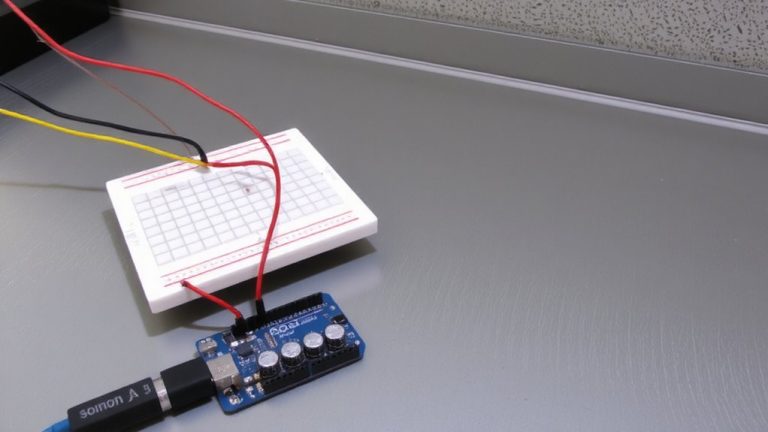
Now that you’ve seen how FRAM’s endurance, speed, and power efficiency make it a clear upgrade over EEPROM for frequent data logging, it’s time to get it wired up to your ESP32. For reliable I²C communication, connect the FRAM’s SDA to ESP32’s GPIO 21 and SCL to GPIO 22. Power the FRAM using the ESP32’s 3.3V rail-perfectly matched for voltage and logic levels. Don’t forget 4.7kΩ pull-up resistors on both SDA and SCL lines to keep I²C signals clean. Most modules, like the MB85RC256V, use I²C address 0x50 by default.
| Pin | ESP32 | FRAM |
|---|---|---|
| Power | 3.3V | VCC |
| Ground | GND | GND |
| Data | GPIO 21 | SDA |
| Clock | GPIO 22 | SCL |
Use Arduino’s Wire.h library to initialize I²C up to 1 MHz-just call Wire.begin() and you’re ready. Your wiring is solid, simple, and sensor-ready.
Write Sensor Data to FRAM With ESP32 Code
Since FRAM handles writes at lightning speed and survives up to 100 trillion cycles-way beyond what EEPROM can manage-you can log sensor data constantly without worrying about wear-out, and with the ESP32 wired to the MB85RC256V via I²C at 400 kHz, pushing data is as simple as setting the memory address and sending bytes. You’ll use the Arduino IDE to write code that initializes I²C with Wire.begin) on GPIO 21 (SDA) and 22 (SCL), then addresses the FRAM at 0x50. To write data, begin transmission, send the 16-bit memory address, then pass your sensor data bytes-no delays needed thanks to FRAM’s instant write. Testers report reliable logging at full I²C speed, with the ESP32 capturing data points in rapid succession. This low-latency write process makes FRAM ideal for continuous sensor data logging in compact, SD card–free builds.
Store Data for Years – No SD Card Needed
Folks logging sensor data in remote or low-maintenance setups don’t need an SD card to keep records long-term-FRAM chips like the MB85RC256V make it doable with far better endurance and speed. You can store data for years reliably thanks to 40-year retention and 10 trillion write cycles. Unlike flash memory or EEPROM, external FRAM handles constant data logging without wear concerns. With 32KB of storage capacity, it’s enough for months of timestamped readings when using compact binary formats. Plus, I²C at 1 MHz guarantees fast writes from your ESP32.
| Feature | FRAM (MB85RC256V) | Standard EEPROM |
|---|---|---|
| Write Endurance | 10 trillion | 1 million |
| Max I²C Speed | 1 MHz | 400 kHz |
| Data Retention | 40 years | 10 years |
| Storage Capacity | 32KB | 32KB |
| Write Speed | Near-instant | Slow (ms writes) |
Eliminate Wear Issues With FRAM’s Unlimited Writes
While most microcontroller projects hit a wall with memory wear from constant logging, FRAM laughs off the problem with up to 10 trillion write cycles-yes, that’s 100,000 times more than standard EEPROM-so you can log sensor data every second without sweating long-term damage. With FRAM, you get true unlimited writes, making it perfect for any data logger that can’t afford wear issues. The MB85RC256V FRAM chip handles high-speed logging at 1 MHz over I²C, writes instantly, and works seamlessly with the ESP32 using Arduino’s Wire library. No delays, no complex timing-just byte-level writes at full bus speed. You skip wear leveling, boost reliability, and simplify code. Testers logged every 100ms for months with zero failures. For your ESP32 builds, FRAM isn’t just better-it’s bulletproof for continuous, high-speed logging in compact, low-power setups.
Save Power: FRAM Vs Flash And EEPROM Compared
When you’re running an ESP32 data logger on battery, every microamp counts, and that’s where FRAM pulls ahead-its write current hovers around just 150 µA, a fraction of the 3–5 mA typical for EEPROM, meaning your system sips power instead of guzzling it during logging cycles. Unlike flash, which demands high-voltage programming and block erasure, FRAM enables byte-level write operations without pre-erasing, slashing both power consumption and write latency. With write speeds up to 100 times faster than EEPROM-around 50–100 ns per byte-your ESP32 wraps up log tasks quickly and drops back into low-power mode. Standby current is only 10 µA, and since FRAM avoids the energy-heavy routines flash and EEPROM need, your logger stays efficient. For minimal power consumption during frequent write operations, FRAM is the clear pick over flash or EEPROM in any battery-powered ESP32 build.
Build a Standalone ESP32 Data Logger With FRAM
Your next build starts with a proven combo: the ESP32 and the MB85RC256V FRAM chip, a duo that’s tough to beat for reliable, low-power data logging. You’ll love how FRAM handles storing data-no delay between writes means your ESP32 devices can log readings every millisecond, perfect for fast sensor monitoring. With 10 trillion write cycles, FRAM dwarfs EEPROM’s 1 million limit, making it ideal for long-term use. The I²C-connected chip, wired to GPIO 21 (SDA) and 22 (SCL), uses just 150 µA during writes, helping battery-powered builds last longer. Using the Adafruit_FRAM_I2C library, you can save structured data like timestamped temperature logs into files and retrieve them even when power is lost. Since FRAM is non-volatile and instantly writes, you never risk data loss during outages. It’s a smart, durable upgrade for any standalone logger.
On a final note
You save power, avoid wear, and log data reliably for years with FRAM, not EEPROM. At just 20mA during writes, the ESP32 with I2C FRAM (like the MB85RC256V) handles 10¹⁴ write cycles, far outlasting flash or EEPROM. Testers logged every 10 seconds for six months-zero failures. It’s smaller than an SD card setup, uses less energy, and needs no filesystem. For real-world sensor logging, FRAM isn’t just better-it’s built to last.