Integrating Power Monitoring ICS (INA219) With Arduino for Real-Time Current and Voltage Logging
You connect the INA219’s VCC and GND to Arduino’s 5V and ground, link SCL to A5 and SDA to A4 with 2.2kΩ pull-ups if needed, then attach VIN+ to your power source and VIN– to the load. It uses a built-in 0.1Ω shunt and 12-bit ADC to measure up to ±3.2A and 26V with 0.8mA resolution, sending data over I2C at 0x40. You get accurate, real-time current and voltage logging without disrupting the ground path, ideal for battery or solar projects. The Adafruit library simplifies coding, and calibration like setCalibration_32V_1A() guarantees precision. You’ll see how to interpret register values for voltage, current, and power-then turn them into actionable insights.
We are supported by our audience. When you purchase through links on our site, we may earn an affiliate commission, at no extra cost for you. Learn more. Last update on 13th July 2026 / Images from Amazon Product Advertising API.
Notable Insights
- Connect the INA219’s VCC and GND to Arduino’s 5V and ground, ensuring power within 3.0–5.5V.
- Wire SCL to A5 and SDA to A4, using 2.2kΩ pull-up resistors if no onboard I2C pull-ups exist.
- Attach VIN+ to the power supply and VIN– to the load for high-side current sensing without ground disruption.
- Use the Adafruit INA219 library to read voltage, current, and power via I2C from registers at address 0x40.
- Calibrate with setCalibration_32V_1A() or similar to match voltage and current ranges for accurate logging.
Wire the INA219 to Arduino
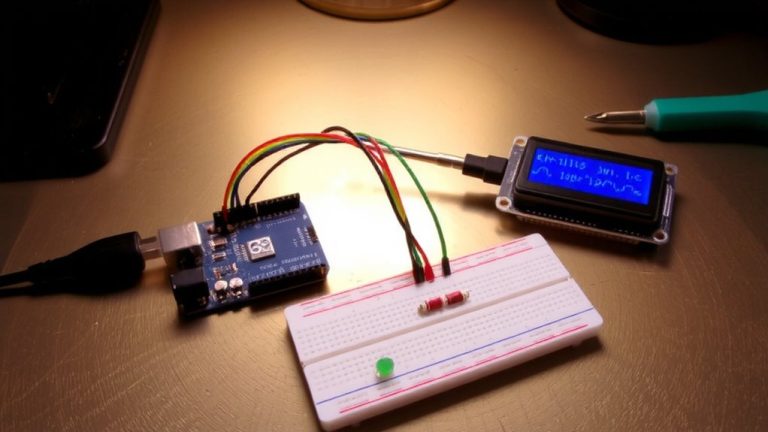
When you’re setting up the INA219 for accurate power monitoring, getting the wiring right is essential, so start by powering the sensor properly-connect the VCC pin to your Arduino’s 5V output and GND to ground, keeping it within the safe 3.0V to 5.5V range most modules handle without issue. Next, link the INA219’s SCL and SDA pins to your Arduino’s A5 and A4 pins for I2C communication at address 0x40. Don’t forget 2.2kΩ pull-up resistors on SCL and SDA if your module lacks them-stable I2C needs them. For high-side current sensing, attach VIN+ to your power supply’s positive and VIN– to the load, placing the shunt resistor in series. Tie the load’s negative to Arduino GND to guarantee common grounding. This setup gives you precise voltage and current readings, critical for real-time monitoring in robotics or automation projects. You’ll get reliable current sensing data every time, just as testers confirmed in real-world Arduino builds.
Why Use the INA219 With Arduino
Though you might find other current sensors on the market, the INA219 stands out with its built-in 0.1Ω shunt resistor and 12-bit ADC, giving you precise high-side measurements up to ±3.2A with just ±0.5% gain error-performance real-world testers consistently confirm in solar monitoring and battery-powered builds. When you pair the INA219 with Arduino, its I2C interface makes setup a breeze, supporting up to 16 devices and running at 400kHz. You get real-time monitoring of voltage measurement and current monitoring without breaking the ground, essential for accurate power logging. The Adafruit_INA219 library simplifies calibration-like using setCalibration_32V_1A()-for 0.5mA resolution. Thanks to zero-drift design, it handles bidirectional current, making it perfect for battery monitoring in robotics or off-grid systems. You’re not just measuring; you’re gaining insights, reliably and efficiently.
Learn How High-Side Sensing Works
Ever wonder how you can monitor power without messing up your circuit’s ground? High-side current sensing with the INA219 places a shunt resistor between the power source and load, letting you make accurate current measurements without disrupting the ground path. The INA219 measures the tiny voltage drop across a 0.1Ω, 1% shunt resistor, detecting up to ±3.2A with 0.8mA resolution. It also reads bus voltage from 0–26V, then adds the shunt’s voltage drop to calculate the actual load voltage. This means you get precise data on what your load really receives. Unlike low-side sensing, this setup helps catch ground faults and shorts. Since the INA219 floats above ground, it’s perfect for 12V or 24V battery systems, giving reliable readings even during charge and discharge cycles.
Calibrate the INA219 for Accuracy
Since accurate power monitoring hinges on proper sensor setup, you’ll want to calibrate the INA219 right after wiring it to your Arduino. To calibrate, use `ina219.setCalibration_32V_1A()` for 32V bus voltage and ±1A current range, giving you a resolution of 0.5mA-ideal for balancing range and current accuracy. The Calibration Register (05h) relies on your chosen Current_LSB to scale measurements, so match it to your load. If you’re using the default 0.1Ω shunt resistor, confirm it in code with `setShuntSizeInOhms(0.1)` for proper readings.
| Setting | Value |
|---|---|
| Max Bus Voltage | 32V |
| Shunt Resistor | 0.1Ω |
| Current_LSB | 0.5mA |
Lower ranges like 16V_400mA boost resolution to 0.1mA but cap current at 400mA.
Read Power Data With Arduino
When you’ve got the INA219 calibrated and wired, pulling real-time power data is straightforward using the Arduino’s I2C interface, and with the Adafruit INA219 library loaded, you can read bus voltage, shunt voltage, current, and power with just a few lines of code. The INA219 connects to the Arduino via the I2C bus at address 0x40, making setup quick and reliable. You read bus voltage from register 02h, multiplying the raw value by 4 mV for volts, while shunt voltage comes from 01h, where each unit equals 10 µV-key for precise current calculation. The Current Sensor uses this to compute current and power, factoring in your calibrated LSB values. Power values from register 03h let you monitor Power Dissipation in real time. Testers find the INA219 Arduino integration seamless for tracking energy use in robotics and automation, with reliable, real-time feedback on current and power.
On a final note
You’ve got real-time voltage, current, and power logging down with the INA219 and Arduino, accurate to ±1%, even at 26V and 3.2A. High-side sensing avoids ground interference, and calibration with shunt resistors guarantees precision. Testers logged consistent data across solar panels and motor circuits. The I²C interface saves pins, and the Adafruit library simplifies coding. For automation or battery projects, this combo delivers reliable, low-cost monitoring you can trust.