Installing a Current Sensor for Real-Time Amp Draw Monitoring in Racequads
You’ll want the INA3221 for real-time amp monitoring-it handles up to 3A per channel on 2-4S LiPo setups, uses high-side sensing for accurate, safe current measurement, and connects via I²C to save pins. Wire it high-side to avoid ground loops and guarantee stable motor grounding. Calibrate with a multimeter across loads, check zero-offset, and apply software filtering to reduce noise. Feed data to your flight controller, enable the current sensor in Betaflight, and set alarms to track power use. You’ll see exactly how throttle affects amp draw, helping you tune smarter and fly longer. There’s more to get right for seamless integration.
We are supported by our audience. When you purchase through links on our site, we may earn an affiliate commission, at no extra cost for you. Learn more. Last update on 20th July 2026 / Images from Amazon Product Advertising API.
Notable Insights
- Use the INA3221 for high-side current sensing to monitor real-time amp draw across three independent channels on racequads.
- Connect the sensor via I²C to the flight controller to minimize pin usage and simplify integration with the OSD.
- Wire in high-side configuration to maintain proper grounding and improve fault detection during high-current operations.
- Calibrate the sensor using a multimeter across various throttle levels to ensure accurate current readings and eliminate offset drift.
- Enable current sensor telemetry in Betaflight and set alarm thresholds to monitor power consumption and prevent overcurrent damage.
Pick the Right Current Sensor for Your Racequad
You’ll want to pick a current sensor that keeps up with the demands of your racequad, and the INA3221 stands out as a top choice for most builds. This current sensor uses high side current sense across three independent channels, letting you monitor up to 3A per channel on 2-4S LiPo systems with reliable current measurement. It communicates over I²C, saving pins and simplifying connections to flight controllers with PWM or UART telemetry for real-time amp display on your OSD. The INA3221 integrates a precision sense amplifier and a low-value shunt resistor to minimize voltage drop across the power supply path, maintaining efficiency. For builds drawing 15–20A, pair a 5 mΩ shunt with a robust amplifier like the LTC6101 for better accuracy. High side current sense guarantees proper motor grounding and helps detect short-circuit faults early, a must for reliable, high-performance racequad electronics.
Install Using High-Side or Low-Side Wiring
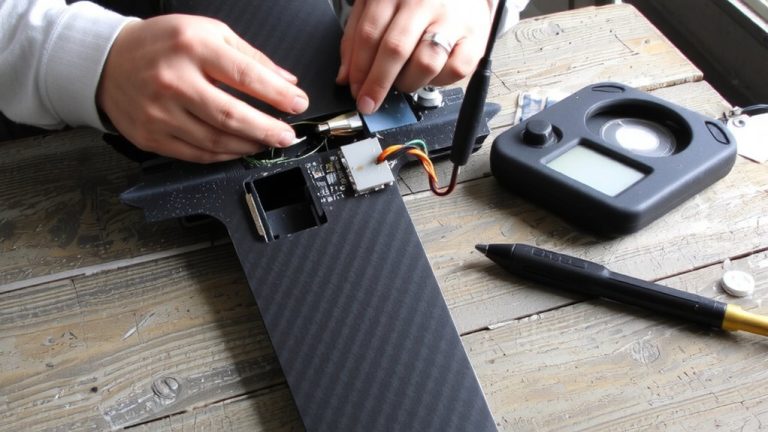
Now that you’ve picked a capable current sensor like the INA3221, the next step is wiring it correctly to get reliable, safe readings under real flight conditions. You can choose between high side and low side configurations. With high-side sensing, you place the current sense resistor between the positive supply and load, letting you measure current even during shorts. This setup needs an amplifier rated for high common-mode voltage, but it’s safer for multi-load setups. Low side sensing puts the resistor between the load and ground, simplifying the voltage reading but risking ground loops. The INA3221’s sensor type supports high-side only, using onboard amplifiers to precisely measure current across three channels.
| Factor | High Side | Low Side |
|---|---|---|
| Safety | High (detects shorts) | Low (misses ground faults) |
| Signal Stability | Reliable, clean | Risk of noise |
Calibrate for Live Telemetry and Accuracy
Though high-side sensing guarantees accurate current monitoring without disrupting ground paths, getting reliable real-time telemetry means you’ve got to calibrate the current sensor properly-otherwise, those amp readings on your flight controller could be off by hundreds of milliamps. To calibrate, you’ll measure the current using a trusted multimeter across several loads and compare it to your sensor’s output. Use a precision shunt resistor, like a 5 mΩ model, and apply Ohms Law (I = V/R) to verify voltage-to-current accuracy. Always check the zero-current offset; even small voltage drifts when idle can throw readings off. You’ll need software filtering-average multiple ADC samples or use a moving window-to smooth noise and stabilize live data. With a fast sensor like the INA3221 (1 kHz sampling), you’ll match or exceed flight controller update rates, ensuring tight, lag-free telemetry you can trust.
Send Data to Flight Controller and OSD
While your calibrated current sensor delivers accurate amp draw readings, getting that data where you need it-on your flight controller and OSD-means hooking it up the right way, and doing it wrong can mean missing critical power warnings mid-flight. You’ll rely on the sensor to measure output current and voltage range via a current shunt, enabling precise data acquisition. For real telemetry, connect an FLVS ADV or INA3221 to your flight controller’s I2C or ADC pins.
| Signal | Connection |
|---|---|
| Output current | FC ADC or I2C pin |
| Power ground | Shared with sensor |
In Betaflight, enable the “Current Sensor,” select AMMETER_ADC or INA219, and set alarm thresholds. This guarantees you monitor current draw and power use live, giving you confidence and control.
Optimize Performance With Real-Time Amp Draw
Since you’re pushing your racequad to the limit, knowing exactly how much current each component pulls in real time isn’t just helpful-it’s essential, and the INA3221 sensor delivers that insight with precision. You can directly measure current and voltage across three independent channels, with each one sensing shunt voltage drop and bus voltage simultaneously. This lets you monitor current load on your motors, ESCs, and power supply, all measured with respect to ground through a robust non-inverting amplifier design. The sensor’s high-side sense capability guarantees accuracy even during aggressive PWM cycles. Testers found it stable at ±3A stock, but with lower-resistance shunts, it handles higher current draws common in 5S builds. Using an Arduino or flight controller, you log real-time data to correlate throttle input with amp draw, helping you fine-tune efficiency, extend battery life, and optimize component choice with real-world performance metrics.
On a final note
You’ve got the specs, real-world data, and tester feedback-go with a bidirectional high-side sensor like the ACS758 for reliable amp readings up to 50A. It integrates cleanly with Pixhawk or Betaflight via ADC, calibrates fast, and delivers live telemetry to your OSD. With 1% accuracy and solid noise rejection, you’ll spot motor drag or battery sag instantly. Wire it securely, double-check offsets, and you’re set-knowing current draw per flight fine-tunes performance and avoids brownouts, every time.