Understanding LiPo Battery Specifications for FPV Drone Performance
You need the right LiPo to maximize your FPV drone’s power and flight time. A 4S 14.8V battery is ideal for 5″ freestyle quads, offering a sweet spot between performance and efficiency, while 6S boosts motor response with less current draw-think 40A instead of 60A for the same punch. Go with 1300–1500mAh for balanced weight and 3–5 minutes of aggressive flight. Don’t trust inflated C ratings; a legit 80C–100C guarantees clean discharge without overheating ESCs. Voltage sag on 4S can drop you below 12V under load, hurting throttle, so balance charge with a JST-XH harness and use XT60 connectors for solid power delivery. Pick 3S for 3″ whoops to stay light and responsive. You’ll see how top pilots match cells, voltage, and discharge to their build’s demands.
We are supported by our audience. When you purchase through links on our site, we may earn an affiliate commission, at no extra cost for you. Learn more. Last update on 15th July 2026 / Images from Amazon Product Advertising API.
Notable Insights
- LiPo cell count (3S, 4S, 6S) determines voltage, affecting motor speed and drone performance.
- Higher voltage (e.g., 6S) reduces current draw, improving efficiency and lowering heat in power components.
- Battery capacity (mAh) influences flight time but must balance with weight for optimal handling.
- C rating indicates discharge capability; match it to your drone’s current draw for reliable performance.
- Balance charging prevents cell imbalance and ensures safety, especially for 4S and higher configurations.
What Is a LiPo Battery and How Does It Work?
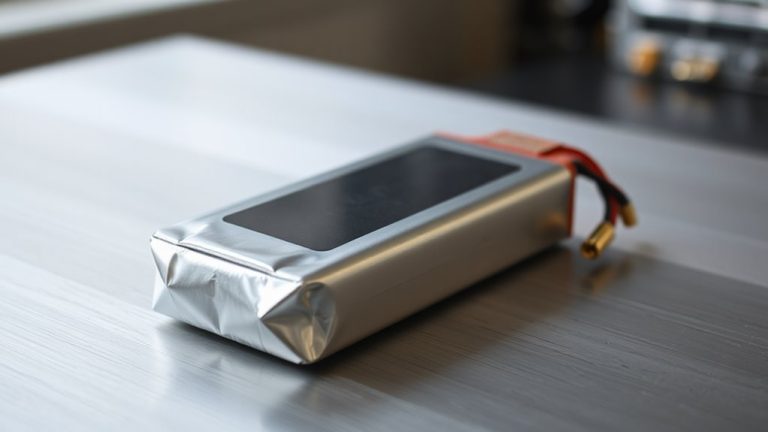
While you’re building or upgrading your FPV drone, understanding the power source is key, and that starts with the LiPo battery-a lightweight, high-performance pack that uses lithium ions and a polymer electrolyte to deliver serious energy on demand. Each lithium polymer cell has a nominal voltage of 3.7V, safely ranging from 3.0V when discharged to 4.2V when fully charged. Going beyond those limits risks damage or danger. These cells are linked in series to boost voltage, increasing power and performance. Thanks to their high energy density, LiPo batteries pack plenty of punch without adding bulk. The polymer electrolyte enables flexible shapes and reliable ion flow between electrodes. Whether you’re hovering or diving hard, your battery’s chemistry and design directly impact flight time and responsiveness, making proper handling and selection essential for every FPV flight.
Voltage Explained: 3S, 4S, and 6S for FPV Drones
If you’re stepping up your FPV game, you’ll want to understand how voltage affects performance, and that means getting familiar with 3S, 4S, and 6S LiPo batteries. Each S represents a cell, and your battery’s voltage depends on how many cells are in series. A 3S LiPo has a nominal voltage of 11.1V, ideal for beginner FPV builds. 4S, at 14.8V, powers most 5-inch freestyle quads, balancing speed and efficiency. Step up to 6S, and you get 22.2V, boosting flight performance with faster motors and sharper throttle response. Higher voltage means lower current draw for the same power-like pulling 40A on 6S instead of 60A on 4S-reducing heat in ESCs and motors. Testers report smoother, more efficient flight, especially in long-range or high-power FPV setups.
Battery Capacity: mAh, Flight Time, and Weight Trade-offs
Since flight time depends on how much energy your battery can store, capacity measured in mAh plays a crucial role in how long you’ll stay airborne-take a 1500mAh pack, for example, pulling 30A on average, and you’re looking at around 3 minutes of solid freestyle flying. Your battery capacity directly impacts flight duration, but don’t overlook weight. Higher capacity means more mAh, yet larger capacity batteries add significant battery’s weight, hurting agility. For 5″ drones, 1300–1500mAh hits a sweet spot, balancing flight time and manageable weight. But cramming a 2200mAh into a 3″ whoop? Expect performance degradation-excess capacity and weight ruin responsiveness. Even at the same mAh, a 6S 1300mAh weighs more than a 4S, altering handling. Always weigh the trade-offs: more mAh isn’t better if it kills your drone’s performance.
C Rating: Real Performance vs. Marketing Hype
| C Rating | Continuous Discharge (1300mAh) |
|---|---|
| 60C | 78A |
| 80C | 104A |
| 100C | 130A |
| 120C | 156A |
| 140C | 182A |
Always match your setup’s current draw-don’t trust the label alone.
How Voltage Sag Hurts Drone Power and Responsiveness
When you’re pulling hard into a dive or punching out of a flip, your drone’s battery can’t keep up with the sudden spike in current demand, and that’s when voltage sag hits-draining power from your motors just when you need it most. That voltage drop happens because of internal resistance in your LiPo battery, especially under high current loads. Even a healthy 4S LiPo can sag from 14.8V down to below 12.0V, slashing motor RPM and dulling throttle responsiveness. Lower-quality cells worsen the issue, no matter their C-rating. A 6S system cuts current draw for the same power-888W at 40A vs. 60A on 4S-reducing sag and boosting efficiency. Severe sag can trigger brownouts, making your drone wobble or drop. Testers report crisper performance on 6S, with smoother power and fewer drops, especially in 5-inch freestyle and racing quads.
Balance Charging and Connector Safety for LiPo Batteries
You just pushed your drone through a high-speed corkscrew and felt that lag at the exit-likely voltage sag from uneven cell performance, which is exactly why balance charging isn’t just routine, it’s how you keep every cell in sync and your power delivery sharp. Using a balanced charger with a JST-XH connector, you monitor each cell’s charge voltage, preventing cell imbalance by ensuring no cell exceeds 4.2V or drops below 3.0V. For 4S packs, that 5-wire balance plug is critical for accurate battery parameters. Always pair this with the right connector types-like the robust XT60 connector on 5″ builds-to avoid resistance and arcing. Never overlook LiPo safety: inspect wires for damage, avoid undersized 28AWG leads, and always charge in a fireproof bag rated to 300°C, especially with high-capacity 6S packs. It’s not overkill-it’s essential protection.
Best LiPo Batteries by Drone Type: 5″, 3″, and Micro
A solid battery can make or break your flight, and for 5″ freestyle or racing quads, you’ll want a 4S or 6S LiPo that delivers clean power without weighing you down. Top-tier LiPo Batteries for FPV like the Tattu R-Line and GNB 6S 1300mAh LiHV offer high discharge rates, stable voltage, and reliable performance under load. For 3″ builds, Dogcom’s 4S 850mAh and 6S 650mAh packs strike a balance between power and size, fitting tight frames while delivering punchy acceleration. When you’re scaling down to micro FPV drones, the CNHL MiniStar 350mAh 2S 7.4V 70C is a top FPV Drone Battery pick-lightweight at just 43 × 19 × 14 mm, it powers Tiny Whoops with consistent output. Whether you’re flying 5″, 3″, or micro quads, trusted Batteries for FPV Drones from Tattu R-Line, Dogcom, and CNHL keep you in the air longer, safer, and more efficiently.
On a final note
You’ll get the most out of your FPV drone by matching the LiPo specs to your build: 4S batteries deliver strong power for 5″ quads, while 3S suits lighter 3″ racers. A real 75C discharge rate beats inflated marketing claims, and 1300–1500mAh balances flight time and weight. Testers confirm minimal voltage sag means crisper throttle response. Always balance charge, use XT60 connectors for safety, and pick quality brands like Tattu or iFlight for reliability in the air.