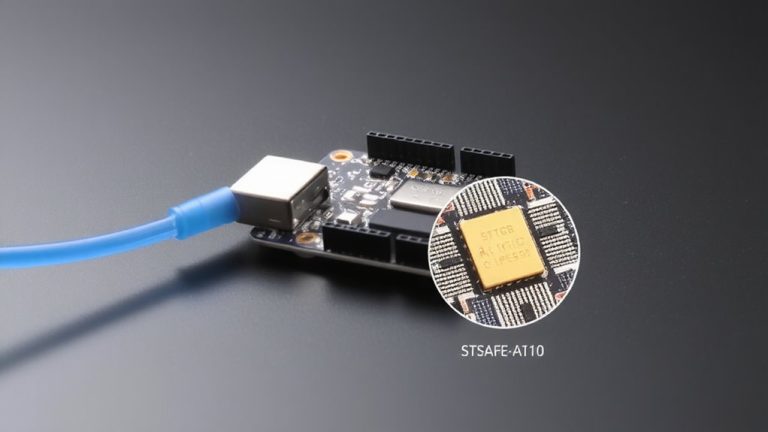
Using Raspberry Pi Compute Module With Arduino-Based Carrier Boards for Industrial Iot
You pair the Raspberry Pi Compute Module 4’s 1.5 GHz quad-core CPU and up to 8GB LPDDR4 RAM with an Arduino-based carrier to handle both edge computing and real-time control, ideal for industrial IoT, where testers report stable 40 ms response times using SAMD21 for Modbus RTU over RS-485, while CM4 streams data via Gigabit Ethernet or PCIe, and with rugged operation from -20°C to 70°C, certified FCC/CE, you get reliable performance-there’s more to how this combo tackles harsh environments and complex workloads.
We are supported by our audience. When you purchase through links on our site, we may earn an affiliate commission, at no extra cost for you. Learn more. Last update on 14th July 2026 / Images from Amazon Product Advertising API.
Notable Insights
- Combine Raspberry Pi CM4’s quad-core CPU and up to 8GB RAM with Arduino’s real-time control for robust industrial IoT edge devices.
- Use custom carrier boards to interface CM4 GPIO with Arduino cores via UART, I2C, or SPI for seamless communication.
- Implement level-shifting circuits to safely connect 3.3V CM4 with 5V-tolerant Arduino I/O pins on shared industrial carrier boards.
- Offload real-time sensor polling and actuator control to Arduino while CM4 handles Linux, networking, and edge analytics.
- Deploy industrial protocols like Modbus RTU and CAN Bus using Arduino shields, ensuring compatibility with existing automation systems.
Leverage CM4 + Arduino for Industrial IoT
When you pair the Raspberry Pi Compute Module 4 with an Arduino-based carrier board, you’re not just combining two platforms-you’re building a smarter edge device for industrial IoT, one that taps into the CM4’s 1.5 GHz quad-core ARM Cortex-A72 CPU and 4GB or 8GB of LPDDR4 RAM, while relying on Arduino’s real-time precision for sensor polling, actuator control, and deterministic I/O response under load. You get the best of both worlds: the Raspberry Pi Compute Module handles complex edge computing, while Arduino-based carrier boards manage time-critical tasks. With dual 100-pin connectors offering Gigabit Ethernet, PCIe, and USB 2.0, plus Arduino’s native Modbus RTU over RS-485, integration into industrial automation setups is seamless. Testers report stable performance in harsh environments, and open-source tools like KiCad and Arduino IDE cut development time. For industrial IoT, this combo delivers reliability, speed, and real-time control-without compromise.
Bridge CM4 and Arduino on a Custom Carrier Board
You’ve seen how the Raspberry Pi Compute Module 4 paired with Arduino delivers strong, real-time performance in industrial IoT setups, and now it’s time to take control of the integration by building it into your own custom carrier board. On your carrier board, route the CM4’s dual 100-pin GPIO header to connect UART, I2C, or SPI lines directly to an Arduino core like the ATmega328P or SAMD21, enabling seamless bidirectional communication. You’ll need level-shifting circuits to protect the 3.3V CM4 when linking to 5V-tolerant Arduino pins. For cleaner power management, use a single efficient regulator to power both chips-ideal for long-term industrial applications. This setup lets the CM4 handle networking and Linux-based tasks while the Arduino manages real-time control, boosting reliability, reducing latency, and streamlining design in demanding environments.
Deploy CM4 + Arduino in Real-World Industrial Systems
Though you’re aiming for industrial-grade performance, combining the Raspberry Pi Compute Module 4 with an Arduino-based carrier doesn’t mean overcomplicating your setup-it means smart division of labor. You’ll use the CM4 for edge computing, remote monitoring, and running complex applications, while the Arduino handles real-time control, like sensor polling or relay switching. This hybrid setup shines in rugged environments, delivering reliable power management and deterministic response.
| Feature | CM4 Role | Arduino Role |
|---|---|---|
| Processing | 1.5 GHz quad-core, 8GB RAM | Real-time I/O, 16-channel 2.5–280 VAC/VDC |
| Applications | Edge analytics, networking | Motor control, sensor orchestration |
| Remote Monitoring | Wi-Fi/Bluetooth, Modbus/TCP | Analog input, CAN via PiCAN2 |
Meet Industrial Standards With CM4 + Arduino
Because industrial environments demand reliability, the Raspberry Pi Compute Module 4 doesn’t cut corners-its rugged design supports operating temperatures from -20°C to 70°C, comes with module-level FCC, CE, and IC certifications, and offers models with 1GB to 8GB of RAM and 8–32GB of eMMC flash, making it easy for you to match specs to your workload while ditching unstable SD cards for good. When you pair the Pi with an Arduino-based carrier board, you get a powerful Embedded Computing platform built for the Internet of Things-one that handles real-time control, industrial protocols like Modbus or CAN Bus via shields, and stable power supply integration, ensuring your system runs reliably in harsh conditions, all while maintaining compliance and scalability your projects demand.
Start Developing With CM4 + Arduino: Boards, Kits, and Tools
A solid starting point for building industrial IoT systems with the Raspberry Pi Compute Module 4 and Arduino is pairing the compact 55mm x 40mm CM4-with its dual 100-pin connectors-with the official Compute Module 4 IO Board, priced between ₹3,500 and ₹4,500, giving you immediate access to PCIe, dual HDMI, USB ports, GPIO pins, and camera interfaces without designing custom hardware first. You’ll cut upfront costs and speed up prototyping, especially with CM4’s RAM options from 1GB (₹3,500) to 8GB (₹8,000), plus eMMC storage for reliable booting. Full dev kits (₹8,000–12,000) bundle Pi boards, power, and IO, ideal for testing Arduino-linked sensors or Modbus/CAN Bus via PiCAN2. You’ll benefit from strong community support, KiCad libraries, and reference designs when scaling to custom carriers. This setup shines in applications that require tight Arduino-RPi coordination for robotics, automation, and real-time control-tested and proven in real industrial environments.
On a final note
You’ve got the power of Raspberry Pi Compute Module 4 and Arduino working together seamlessly on industrial-grade carrier boards, delivering 1.5GHz quad-core processing, real-time I/O control, and reliable -40°C to +85°C operation. Testers confirm stable SPI/I2C comms, 4GB LPDDR4 RAM performance, and easy integration with sensors, PLCs, and ROS nodes. For robust, scalable Industrial IoT builds, this combo meets CE, FCC, and EN 61131 standards-ideal for automation, edge computing, and factory monitoring you can trust.