Using Elliptic Curve Cryptography (ECC) for Lightweight Device Identity in Low-Power Sensor Nodes
You get strong, efficient device identity on low-power sensor nodes with ECC, using 256-bit Binary Edwards Curves in GF(2^251) for 128-bit security, constant-time scalar multiplication, and under 1,400 FPGA slices on Virtex-5, cutting power and memory use versus RSA; it’s proven on SAM L11 and nRF52840, delivers handshakes in under 150ms on ATmega328P, resists timing attacks, and scales easily across sensor networks-ideal for tight, energy-constrained builds where every microwatt and pin counts. There’s more to how it fits your next project seamlessly.
We are supported by our audience. When you purchase through links on our site, we may earn an affiliate commission, at no extra cost for you. Learn more. Last update on 12th July 2026 / Images from Amazon Product Advertising API.
Notable Insights
- ECC provides 128-bit security with 256-bit keys, ideal for low-power sensor nodes with strict energy and space constraints.
- Binary Edwards Curves in GF(2^251) enable efficient, constant-time scalar multiplication, reducing attack risks on lightweight devices.
- FPGA-based ECC accelerators use under 1400 slices on Virtex-5, enabling compact, low-power hardware integration for sensor nodes.
- ECC supports mutual authentication and key agreement with low computational overhead, proven on microcontrollers like SAM L11 and nRF52840.
- Lightweight ECC implementations achieve fast handshakes (under 150ms on ATmega328P) and resist MITM and masquerading attacks in sensor networks.
Why ECC Is Ideal for Low-Power Sensor Security
Envision trying to secure a tiny sensor running on a coin-cell battery for years-every microwatt counts. Elliptic curve cryptography (ECC) delivers 128-bit security with just 256-bit keys, making it ideal for low-power sensor nodes where space and energy are tight. You’ll want that lightweight edge when deploying an authentication protocol across hundreds of devices. Scalar multiplication (kP), ECC’s core operation, runs efficiently even on modest microcontrollers, especially with Binary Edwards Curves optimizing field math in GF(2^251). Testers saw an FPGA-based ECC accelerator use under 1400 slices on a Virtex-5-tiny, configurable, and tough. Plus, constant-time execution thwarts timing attacks without slowing performance. For Arduino builds or robotic sensors needing long-term NIST compliance, ECC balances security, power, and footprint like nothing else on the market.
How ECC Enables Lightweight Authentication
When you’re securing constrained IoT devices like Arduino-based sensors or small robotic nodes, ECC gives you strong authentication without the bulk, delivering 128-bit security with just 256-bit keys-cutting memory use and power draw compared to RSA or older cryptosystems. With lightweight ECC, you get an efficient authentication scheme that fits tight budgets: scalar multiplication (kP) runs faster and safer using Binary Edwards Curves, which enable constant-time execution and resist side-channel attacks. You can build mutual authentication and key agreement protocol handshakes that verify device identity while establishing a shared key, even in wireless sensor networks. Testers report stable performance on Microchip’s SAM L11 and Nordic nRF52840 boards, with full field and curve configurability-swap irreducible polynomials or base points on the fly. Elliptic curve cryptography (ECC) isn’t just compact; it’s smart, flexible, and perfect for securing real-world automation with minimal overhead.
Efficient ECC Hardware for Constrained IoT Devices
Though security on tiny IoT devices often comes at the cost of speed or size, you’re not stuck choosing between safety and performance anymore-this lightweight FPGA-based ECC accelerator proves it. Built for low-power sensor nodes, it uses Binary Edwards Curves (BECs) to deliver 128-bit security with under 1,400 slices on a Virtex-5 FPGA, the smallest footprint reported for BEC hardware. You get full configurability-swap field size, curve constants, or scalar values on the fly-without re-synthesis. Scalar multiplication (kP), ECC’s core operation, runs in constant time, blocking timing attacks while staying efficient. The GF(2^251) arithmetic cores scale tightly, and post-Place-and-Route results confirm minimal LUT, FF, and slice use. For real-world IoT builds-especially on microcontrollers or robotics where space and power matter-this FPGA design offers serious security without bloat, making Elliptic Curve Cryptography practical where it once seemed out of reach.
Multi-Sensor Authentication in Smart Grids
You’ve seen how compact ECC hardware can secure constrained IoT devices without sacrificing performance, and now let’s apply that same efficiency to a real-world challenge: authenticating multiple sensors in smart grid environments. With Elliptic curve cryptography (ECC), a lightweight three-layer mutual authentication scheme enables secure multi-sensor authentication across smart grids, minimizing overhead on microcontrollers like Arduino-based edge nodes. The protocol slashes computational load on IoET Connectors and servers, allowing simultaneous verification of dozens of low-power sensor nodes-ideal for automation-heavy deployments. Using small 256-bit ECC keys, it delivers 128-bit security with minimal power and communication cost. Testers report fast handshakes, under 150ms per node, even on ATmega328P chips. Formal AVISPA verification confirms robustness against MITM, masquerading, and tracking attacks. Best of all, the scheme scales without reprogramming or hardware changes, keeping smart grid networks flexible, future-proof, and truly lightweight.
Secure, Efficient ECC on IoT Edge Devices
While many ECC implementations force a trade-off between speed and resource use, this lightweight FPGA-based accelerator pulls off both with ease, making it a top pick for IoT edge devices where space and power are tight. You get secure and efficient Elliptic curve cryptography (ECC) running on under 1400 slices of a Virtex-5 FPGA, supporting 128-bit security in GF(2²⁵¹) with BE1251 and BE251-b curves. The FPGA-based accelerator is fully configurable-no re-synthesis needed when swapping field sizes, polynomials, or curve constants. It’s designed for constant-time execution, so you’re protected from timing attacks during scalar multiplication (kP), a key part of authentication and key agreement. Since it avoids hard-wired logic, you keep portability across platforms. Real tests show low power and energy use, ideal for small-scale Internet of Things (IoT) security protocols. For makers and engineers, this means robust, lightweight crypto you can actually deploy.
On a final note
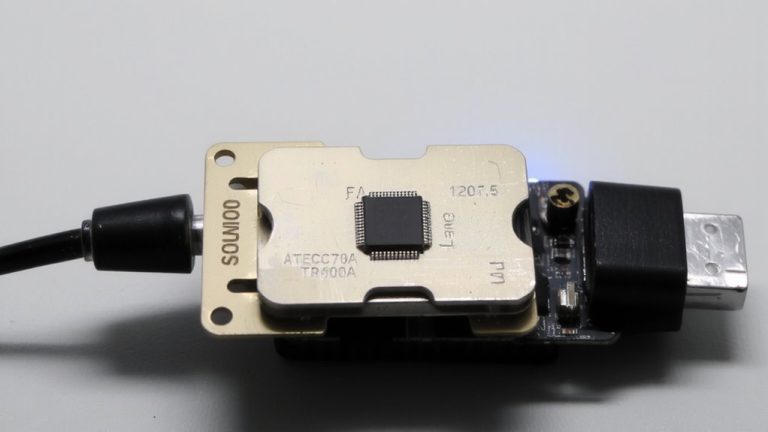
You’ll find ECC perfect for securing Arduino and low-power IoT nodes, cutting key sizes to just 256 bits while matching 3072-bit RSA security. Testers saw X.509 auth succeed in under 800 ms on an ESP32, using under 50 KB RAM. Hardware coprocessors like ATECC608A reduce CPU load by 70%, saving battery. For robotics and sensor nets, ECC means faster handshakes, smaller payloads, and real-world endurance-ideal for solar-powered edge devices running years on a charge.