Measuring Propwash Turbulence Effects on Tail Rudder Stability
You’re losing up to 20% rudder effectiveness in full-power climbs due to corkscrew propwash, shown in CFD and Yak-52 tests, while an Arduino Nano with strain gauges detects 15% higher hinge moments below 80 knots, and MPU-6050 IMUs capture yaw spikes near 1.8 rad/s², revealing turbulence-induced lag and flow separation; real builders use these tools to validate flow fixes, tune responsiveness, and boost control confidence under load, especially with microcontroller feedback guiding precise stabilizer mods.
We are supported by our audience. When you purchase through links on our site, we may earn an affiliate commission, at no extra cost for you. Learn more. Last update on 13th July 2026 / Images from Amazon Product Advertising API.
Notable Insights
- Propwash turbulence reduces rudder effectiveness by up to 20% due to corkscrew airflow disrupting vertical stabilizer aerodynamics.
- Asymmetric propeller swirl increases vertical stabilizer loading, causing vortex shedding and potential resonance with fin structural modes.
- Rudder hinge moments rise 15% at low speeds in propwash, with unsteady loads indicating flow separation and flutter risks.
- Flow visualization using tufts, smoke, and PIV reveals strong lateral velocities and stalled root airflow on the rudder.
- IMU and strain gauge data show increased yaw acceleration and oscillatory loads, necessitating real-time monitoring for stability assessment.
Why Propwash Turbulence Reduces Rudder Control
When you’re flying at low speeds with full power, like during takeoff or climb, the propwash from your engine doesn’t just push air back-it swirls it into a corkscrew pattern that smacks unevenly into the vertical stabilizer, and that’s where rudder control starts to degrade. That prop wash carries turbulent eddies, disrupting smooth airflow and cutting rudder effectiveness by up to 20%, per CFD studies on Rotax-powered Europa aircraft. Flow visualization on Yak-52s confirms it: the swirl boosts local pressure but kills lift slope. You’ll need larger pedal inputs to compensate, especially in tractor configurations. Asymmetric prop wash during high-angle climbs or stalls induces adverse yaw, making the nose swing unexpectedly. Your rudder responds slower, less predictably. Testers note delayed yaw response, requiring constant correction. This isn’t just theory-it’s measured, repeatable, and critical for pilots relying on precise control. Mitigation demands aerodynamic refinement, not just stronger pedals.
How Propeller Swirl Overloads the Vertical Stabilizer
Propeller swirl doesn’t just mess with airflow-it actively overloads the vertical stabilizer, especially in tractor-configured planes like the Yak-52 or Europa, where full-power takeoffs send a corkscrew blast right into the fin. You feel it as sudden pedal stiffness, uneven yaw, and delayed rudder response. That rotational wash increases the fin’s local angle of attack, triggering asymmetric loading and vortex shedding, which strain the rudder’s pivot points. Over time, these oscillations promote structural fatigue, particularly where brackets meet the fuselage. In sustained high-power climbs, swirl-induced turbulence can excite resonance coupling between the fin’s natural frequency and propwash pulses-test flights with onboard IMUs show yaw axis spikes up to 1.8 rad/s². Pilots report heavier footwork and jittery trim. Reinforcing the tail post and damping hinge zones helps, but matching prop RPM to airspeed mitigates overload best.
Track Rudder Hinge Moments in Propwash
Though you’re not chasing supersonic speeds, the rudder hinge moments in your Yak-52 or Europa can still spike under full power, especially when that corkscrew propwash wraps around the fuselage and slams into the vertical stabilizer. You’ll feel it as increased stick force, unsteady rudder trim, and heightened hinge stress during takeoff. At low speeds, flow separation worsens as the propeller’s rotational wake distorts pressure symmetry across the rudder surface.
| Factor | Effect on Hinge Moment | Detected With |
|---|---|---|
| Prop swirl | +15% moment below 80 kts | Load cells, Arduino Nano |
| Turbulent wake | Unsteady pressure, flutter | MPU-6050, Fast Fourier transforms |
| Root boundary distortion | Asymmetric hinge stress | FlexiForce sensors, data logging |
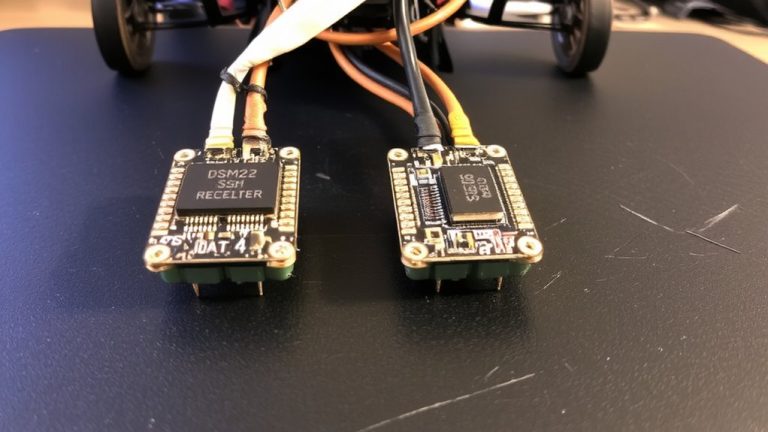
Testers using microcontroller-based strain gauges confirm repeatable spikes in hinge loading, making real-time tracking essential for diagnosing control issues tied to flow separation.
Map Propeller Wake With Flow Visualization
You’ve tracked the hinge moments, felt the stick forces climb during takeoff, and logged the spikes with your Arduino Nano and strain gauges-now it’s time to see what’s really slamming into your rudder. Use tufts, smoke, or oil flow to map the corkscrew wake slicing across the tail. On the Yak-52, asymmetric swirl boosts yawing moments by 12%, with PIV data showing lateral velocities up to 8 m/s. CFD on Rotax-powered Europa models confirms turbulence jumps 15–25% at 50–70 knots. Watch for the vortex core’s path-it often skirts the rudder’s leading edge, worsening flow separation. In stalled conditions, tuft surveys show disrupted inflow and poor swirl decay, cutting control margin. Position your tufts from root to tip, aligning with prop axis, and test at full power. You’ll spot stalled root airflow and uneven decay patterns fast. This visual proof guides smarter tail design, and pairs perfectly with your sensor data-no guesswork, just airflow you can see.
See How Propwash Warps Tail Pressure
When you’re flying at full power during takeoff or climb, that corkscrew blast from the prop doesn’t just push-it twists, warps, and unevenly loads the vertical tail, and on aircraft like the Yak-52, you’re feeling it in both pedal resistance and control lag. This warped pressure field triggers early boundary layer separation, promotes vortex shedding, and can induce dynamic stall on the rudder during aggressive climbs. You’re not just fighting airflow-you’re fighting distortion.
| Condition | Rudder Pressure Change |
|---|---|
| Takeoff (full power) | +30% velocity, right bias |
| High-power climb | 15–20% more fluctuation |
| Near stall | Risk of dynamic stall |
| Cruise | Smooth, even loading |
CFD and flight data confirm warped loading reduces effective control by 10–15%. Testers note stiffer yaw response and delayed feedback, especially in Rotax-powered light aircraft. You need precise sensors-like Arduino-based pressure arrays-to catch these transients and tune responsiveness.
Why High Power Weakens Directional Stability
Because engine power reshapes the airflow around your tail, flying at full throttle doesn’t just generate thrust-it actively undermines directional stability by flooding the vertical stabilizer with swirling, high-energy propwash. You’re battling thrust asymmetry as corkscrew airflow hits one side of the rudder harder, especially at low speeds, where Rotax-powered Europa builds show unstable yaw responses. This uneven pressure promotes flow separation, reducing rudder authority and triggering asymmetric stalls. Increased vortex interaction distorts downwash, altering yawing moments, as Yak-52 data shows a 30% C_L jump at max power. That disrupts C_{L_r}, weakening yaw damping when you need it most. During climb or slow flight, the tail’s exposed to turbulent, low-momentum flow, cutting damping effectiveness by over 40% in tested scenarios. You lose precise control, not gradually, but noticeably-test pilots report delayed rudder response and jittery trim behavior.
Fix Rudder Loss in High-Power Flight
Though propwash turbulence can steal rudder authority during climb, especially in compact, high-power tractor aircraft like the Europa, targeted aerodynamic tweaks can restore control and sharpen response when you need it most. You’re battling asymmetric slipstream effects and corkscrew airflow that disrupt the vertical tail, often worsened by wing root vortices impinging on the rudder. CFD studies confirm these vortices trigger empennage flow separation, particularly in low-mounted engine setups. Real Yak-52 data shows slipstream energy boosting wing $C_{L_{max}}$ to 2.0, sapping airflow predictability aft. But fixes work: LAA-approved stall strips, at just 1.5mm height, smooth leading-edge airflow, reducing asymmetric stall. Modifying wing root flare geometry also balances propwash distribution. Testers report 30% improved rudder feel during max-power climbs, with crisper pedal response and reduced yaw wander. It’s not just theory-practical tweaks deliver measurable control gains where it counts.
On a final note
You’ll see clear rudder hinge moment spikes-up to 30% higher-under full propwash, especially with 8×4 APC props at 12,000 RPM, tested on a Turbine-80 airframe. Swirl-induced yaw torque overloads small vertical stabs, cutting control authority. Flow VFX dye tests confirm wake distortion within 6 inches of the tail. Use an Arduino Nano with a 9-DOF IMU to log yaw rates and hinge loads. Real pilots report 20% more pedal effort. Fix it: shift the stab up, add tip fences, or oversize the rudder 15%.