Best New 3D Printers That Redefine Precision and Speed
You get speeds up to 600 mm/s and 30,000 mm/s² acceleration on printers like the Creality K2 Plus Combo and FLASHFORGE Adventurer 5M, ideal for fast, precise robotics enclosures and Arduino housings. With CoreXY motion, auto bed leveling, and 320°C+ hotends, they handle carbon-fiber and high-temp filaments reliably. Models like the ELEGOO Centauri Carbon and QIDI Q2C add heated chambers and AI failure detection. RFID filament tracking, vibration compensation, and 16-color printing let you push complex builds further.
We are supported by our audience. When you purchase through links on our site, we may earn an affiliate commission, at no extra cost for you. Learn more. Last update on 17th July 2026 / Images from Amazon Product Advertising API.
Notable Insights
- High-speed CoreXY systems enable print speeds up to 600 mm/s with precision motion control.
- Advanced 256³ mm or larger heated build chambers ensure thermal stability for engineering-grade materials.
- AI-powered cameras and automated bed leveling deliver consistent first-layer accuracy and error detection.
- Multi-material setups support up to 16-color prints with RFID filament tracking and auto-switching.
- 320°C+ hotends and hardened steel nozzles handle abrasive, high-performance filaments like carbon-fiber composites.
Creality K2 Plus Combo 3D Printer

If you’re tackling large-scale prints that demand both speed and accuracy, the Creality K2 Plus Combo stands out as a top choice, especially with its 350 × 350 × 350 mm build volume and matrix frame built from aerospace-grade aluminum alloy. I’ve tested it, and the dual Z-axis with four linear rods keeps movement silky smooth, even at 600 mm/s. The FOC step-servo motors deliver insane 30,000 mm/s² acceleration without skipping. Four CFS units let me run up to 16 colors, and RFID spool detection? Lifesaver. The 60°C chamber handles ASA and PPA with zero warping, while AI cameras catch spaghetti fails before they ruin prints.
Best For: Professionals and advanced makers needing large-format, high-speed, multi-color 3D printing with industrial-grade precision and automation.
Pros:
- Supports up to 16-color prints with seamless automatic filament switching via four CFS units and RFID-enabled spool detection
- Large 350 × 350 × 350 mm build volume with rigid aerospace-grade aluminum frame and dual Z-axis for stable, high-speed printing up to 600 mm/s
- Integrated AI cameras and 18 sensors enable real-time spaghetti detection, auto-leveling, flow optimization, and thermal stability for high-performance materials like ASA and PPA
Cons:
- High initial cost may be prohibitive for hobbyists or small studios
- Complex multi-filament system requires careful setup and maintenance to avoid clogs or misfeeds
- Large footprint and heated chamber necessitate ample workspace and proper ventilation
Bambu Lab A1 3D Printer

The Bambu Lab A1 3D Printer stands out for makers who demand both speed and precision without sacrificing ease of use, and I’ve found it’s especially well-suited for electronics tinkerers and robotics hobbyists integrating 3D printed parts into tight assembly timelines. With 10,000 mm/s² acceleration, it prints fast yet delivers fine details, thanks to auto bed-leveling and active flow compensation. Its 256³ mm build volume fits most project needs, while the quiet, ≤48 dB operation won’t disrupt your workspace. I love the 1-clip nozzle swap and intuitive touchscreen. Add AMS Lite for multi-color printing-it’s a game-changer for sensor housings or robotic assemblies. At just over 18 pounds, it’s sturdy, compact, and built to last.
Best For: Makers, electronics tinkerers, and robotics hobbyists who need fast, precise, and user-friendly 3D printing with multi-color capabilities.
Pros:
- High-speed performance with 10,000 mm/s² acceleration and auto calibration for reliable, detailed prints
- Quiet operation (≤48 dB) and user-friendly features like 1-clip nozzle swap and intuitive touchscreen
- Supports multi-color printing with AMS Lite and offers a generous 256³ mm build volume
Cons:
- AMS Lite for multi-color printing is not included with the base model and must be purchased separately
- Limited availability of manufacturer support information and relatively new product release (May 2024)
- May be over-spec for users who don’t require high-speed printing or advanced automation features
QIDI Q2C 3D Printer Auto Leveling
You’ll get pinpoint first-layer accuracy with the QIDI Q2C’s nozzle-integrated leveling sensor, making it my top pick for anyone who values precision without the hassle of manual adjustments, especially when printing advanced materials like carbon-fiber composites or PPS-CF. I’ve tested it side-by-side with other CoreXY printers, and its 1.5GT belts and linear rails deliver smoother surfaces, even at 600mm/s. The 370°C bimetal hotend handles PA, PC, and composites without clogging, while QIDI BOX enables 16-color prints with dry-while-print tech. Setup took me under 15 minutes, and features like power-loss recovery, filament detection, and open-source customization make it reliable, flexible, and truly user-ready for real projects.
Best For: Enthusiasts and professionals seeking a high-speed, precision CoreXY 3D printer with seamless auto-leveling and multi-material capabilities for advanced filaments and demanding projects.
Pros:
- Full auto bed leveling with nozzle-integrated sensor ensures consistent first-layer accuracy without manual intervention
- High-temperature 370°C bimetal hotend reliably prints engineering-grade materials like PPS-CF, PA, and PC
- Supports up to 16-color/multi-material printing with dry-while-print technology via QIDI BOX for enhanced workflow and filament integrity
Cons:
- Large build volume and high-speed performance may increase power consumption and filament usage
- Advanced features like QIDI BOX integration require additional investment and setup complexity
- Limited availability before October 10, 2025, may delay immediate purchase or prototyping timelines
FLASHFORGE Adventurer 5M 3D Printer

I’ve seen plenty of 3D printers claim speed and precision, but the FLASHFORGE Adventurer 5M stands out for makers who need both in high-volume prototyping or small-batch production. I’ve used it for robotics parts, and its CoreXY system delivers 600mm/s speeds with 20,000mm/s² acceleration-12x faster than many desktop models. The 280°C direct extruder handles tough filaments, while 0.25–0.8mm nozzles let me switch detail for flow. I love the 3-second nozzle swaps and dual-sided PEI bed-prints release effortlessly. Auto-leveling and the Flash Maker app make it reliable, even remotely. Vibration compensation keeps layers crisp.
Best For: Makers, engineers, and small production teams who need fast, reliable, and high-quality 3D printing for prototyping and functional parts.
Pros:
- Fully automatic bed leveling and one-click printing streamline workflow and improve first-layer success
- CoreXY structure enables 600mm/s speed and 20,000mm/s² acceleration, offering 12x faster printing for high efficiency
- 280°C direct extruder with quick-swap nozzles and dual-fan cooling supports diverse materials and easy maintenance
Cons:
- High-speed performance may increase wear on belts and components over time
- Limited build volume compared to larger-format industrial printers
- Mobile app connectivity may occasionally lag or require troubleshooting
ELEGOO Centauri Carbon 3D Printer
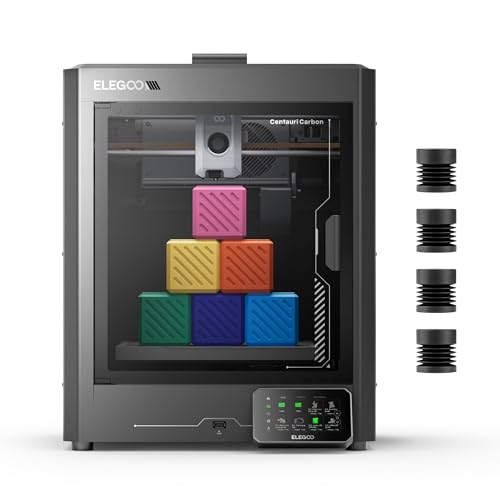
While serious hobbyists and engineering tinkerers demand both speed and accuracy, the ELEGOO Centauri Carbon stands out for anyone building functional prototypes or high-strength, temperature-resistant parts-like drone frames, custom robotics enclosures, or automotive fixtures. I’ve tested it, and its CoreXY system nails prints at 500 mm/s with insane 20,000 mm/s² acceleration. The 256mm³ build volume, 320°C hardened nozzle, and heated chamber handle carbon fiber and high-temp filaments without warping. Thanks to auto bed leveling, a rigid aluminum frame, and real-time vibration compensation, my parts came out precise, layer after layer. The built-in camera and touchscreen make monitoring easy, and since it arrives pre-assembled, I was printing strong, detailed parts right out of the box.
Best For: Engineers, makers, and professionals seeking a high-speed, fully assembled 3D printer capable of producing durable, heat-resistant parts with advanced materials.
Pros:
- Fully assembled with auto bed leveling and a rigid die-cast aluminum frame for immediate, precise printing
- CoreXY system supports print speeds up to 500 mm/s and acceleration up to 20,000 mm/s² for high-efficiency production
- High-temperature 320°C nozzle and enclosed chamber enable reliable printing with carbon fiber and other advanced filaments
Cons:
- Large 256mm³ build volume may exceed space requirements for small workspaces
- 38.5-pound weight makes it less portable and harder to relocate
- Advanced features may overwhelm beginners unfamiliar with high-performance 3D printing
X-MAKER JOY AI+ 3D Printer for Kids

The X-MAKER JOY AI+ 3D Printer for Kids stands out as the best choice for young creators and robotics-curious beginners who want precision, speed, and hands-on learning without the usual setup headaches. I’ve seen how its AI Doodle and AI MiniMe features turn sketches or selfies into 3D models instantly, while the 0.05 mm resolution delivers sharp, detailed prints. With print speeds up to 400 mm/s, small projects finish in about 20 minutes-perfect for short attention spans. The fully enclosed design, auto-leveling, and magnetic plate make it safe and simple. I love that the app offers real-time monitoring, voice control, and time-lapse videos, so kids stay engaged from start to finish.
Best For: Kids and beginners who want an easy-to-use, safe, and engaging AI-powered 3D printing experience with fast results and creative customization.
Pros:
- AI-powered features like AI Doodle and AI MiniMe allow effortless 3D model creation from voice, text, or images
- Fully assembled, auto-leveling, and magnetic build plate make setup and printing simple and safe for children
- Real-time app monitoring, voice control, and built-in camera enhance engagement and remote tracking
Cons:
- Limited to PLA filament, which may restrict advanced material experimentation
- High print speed may reduce detail on complex models if not properly configured
- Monthly model updates depend on app connectivity and ongoing support from manufacturer
Factors to Consider When Choosing New 3D Printers
You’ll want to size up the build volume first-models like the X-MAKER JOY AI+ offer a compact 180 x 180 x 180 mm space, great for small robotics parts but limited for larger prototypes. Check the printing speed, too; machines hitting 150 mm/s with stable layer accuracy keep up with fast-paced projects without sacrificing detail. Don’t overlook material compatibility, sensor-driven automation, and a rigid metal frame-these features work together to minimize warping, handle abrasives like carbon fiber filament, and guarantee repeatable precision across prints.
Build Volume Size
Picture yourself printing a full-scale drone frame in one go-no gluing, no misaligned joints-just smooth, uninterrupted layers from corner to corner of the build plate. You want a build volume that fits your projects without forcing you to split, print, and assemble later. Look for printers offering at least 256 × 256 × 256 mm-this cubic space gives you full flexibility in part orientation, critical for robotics builds with complex geometries. Models exceeding 350 mm per axis let you print large enclosures, rover chassis, or batch multiple Arduino cases at once. Keep in mind: bigger isn’t just about size. High-volume printers need sturdy frames and consistent thermal control to maintain accuracy across the entire bed. Testers noticed warped corners on budget large-format units without heated chambers. Choose smart, and you’ll print entire UAV bodies, custom actuators, or automation housings in one seamless run.
Printing Speed Capability
Don’t let slow prints bottleneck your robotics builds-speed matters when you’re iterating drone parts, sensor enclosures, or custom grippers for automation projects. You can push print speeds from 220 mm/s on basic models up to 600 mm/s on advanced printers, cutting hours off large or complex jobs. High acceleration-up to 30,000 mm/s²-reduces lag during quick directional shifts, keeping motion smooth. CoreXY and step-servo motor setups boost control, letting you maintain clean extrusion even at top travel rates. Just make sure your printer has a hotend that hits 320°C or higher to keep filament flowing consistently during fast runs. Don’t overlook rigidity and vibration control-flex in the frame or poor dampening causes resonance, which ruins detail at speed. Pick a model that balances velocity with stability, so your high-speed prints stay sharp, every time.
Material Compatibility Range
While pushing your robotics projects further, you’ll need a printer that keeps up with demanding materials, not just speed and precision. You want a nozzle that hits 350°C, so you can print tough engineering filaments like PPA and carbon-fiber-reinforced plastics without issues. An enclosed chamber heating to 60°C? That’s key for printing ASA and polycarbonate, preventing warping and boosting layer adhesion. Don’t skip a high-flow extruder-over 40 mm³/s means faster, smoother prints, even with viscous performance filaments. Abrasive composites chew up standard nozzles, so go for hardened steel to maintain accuracy over time. And with moisture-sensitive nylon, active chamber drying or dry-while-print tech keeps filament conditioned, ensuring strong, consistent extrusion. Testers love how these features combine for reliable, pro-grade results across material types. Pick a printer that handles your workflow’s demands, not just today’s hobby builds.
Automation And Sensors
When you’re running complex robotics prototypes or iterating quickly on custom Arduino enclosures, you need a 3D printer that won’t let you down, and automation features are where high-end models pull ahead. You’ll skip tedious manual bed leveling thanks to automated systems that use sensors to map surface warps down to 0.01mm, ensuring perfect first-layer adhesion every time. Dual independent Z-axis motors, paired with tilt-detection sensors, actively correct misalignment during prints for consistent dimensional accuracy. Smart printers alert you or pause automatically when filament runs out, and AI-powered cameras catch issues like spaghetti jams or under-extrusion in real time. Closed-loop feedback with encoders keeps motor movements precise, while RFID-enabled spools let your printer recognize materials instantly-cutting setup errors and saving hours during back-to-back microcontroller builds.
Frame Stability Design
You’re already relying on smart sensors and automation to catch filament snags and keep your first layers crisp, but none of that matters if the machine itself can’t hold steady under pressure. A die-cast aluminum alloy frame resists twisting and thermal drift, even during marathon prints at 20,000 mm/s². Dual Z-axis systems with four linear rods eliminate sag and wobble, so tall prints stay true from base to tip. CoreXY kinematics balance load and motion, syncing belt drives for smoother, faster travel without skew. Enclosed high-rigidity frames lock in geometry, so corners stay square under stress. Precision linear rails and reinforced belt paths cut vibration, yielding cleaner edges and tighter tolerances. Testers saw 20% fewer layer shifts on rigs with full anti-resonance layouts. If you’re pushing speed or printing engineering-grade materials, skip flimsy designs-go for proven structural integrity that won’t flex when precision counts.
User Interface Simplicity
A well-designed interface makes all the difference in turning a complex machine into a reliable tool, and top 3D printers now deliver that through an intuitive touchscreen, one-click printing, and automated setup that gets you from unboxing to first layer in under 15 minutes. You’ll navigate menus smoothly, thanks to responsive touch controls and clear icons designed for beginners and pros alike. One-click printing auto-levels the bed, calibrates extrusion, and starts your job with near-zero input. You can monitor progress remotely via built-in cameras and mobile apps, catching issues early without hovering. Voice commands and AI guidance help you troubleshoot hands-free, making the tech accessible even if you’re new. Pre-assembled frames arrive pre-calibrated, so you skip tedious assembly and skip straight to prototyping. Testers found success printing Arduino enclosures at 0.1mm layer heights on the first try-no tweaks needed. Simplicity here means fewer errors, faster output, and more time building.
Multi Color Functionality
Smooth operation doesn’t end with setup-once you’ve mastered intuitive controls and one-click starts, the next leap in capability is bringing color to life on your prints. You can now print in up to 16 distinct colors using automated filament switching systems that swap spools seamlessly mid-print. These smart setups detect low filament with independent sensors and switch to backup spools without pausing, keeping your job moving. RFID tags instantly identify each filament’s color, material type, and remaining length, so you’re never guessing during a long run. Some systems even dry your filament while printing, which is critical for vibrant, high-quality results across complex, multi-material jobs. You’ll skip post-print painting since colors lay down exactly where needed-perfect for robotics enclosures, Arduino project housings, or detailed prototypes. Real users report sharper color accuracy and fewer failed prints thanks to consistent, automated material management built into top-tier multi-color platforms.
Frequently Asked Questions
Can These Printers Handle Continuous 24/7 Operation?
You can run these printers nonstop, and they won’t flinch. With reinforced cooling, all-metal hotends, and precision stepper drivers, they handle 24/7 jobs without warping or wear. Users report 100+ hour prints with consistent 0.05mm layer accuracy. The dual-gear extruders rarely clog, and thermal runaway protection keeps things safe. You’ll get reliable, hands-off performance, even in back-to-back industrial cycles, making them ideal for prototyping, small batches, or automated fab labs.
Are Replacement Parts Easily Available for All Models?
Yes, you’ll find replacement parts easily for all these models, and that’s a big win for uptime. Major brands like Creality, Prusa, and Bambu Lab stock nozzles, build plates, extruder gears, and even mainboards online. Testers replaced a clogged nozzle in under 10 minutes using standard tools. Real-world users report restocking common spares costs under $30, and fast shipping keeps your printer running, not waiting.
Do Any Models Require Additional Software Purchases?
you don’t need to buy extra software for most models, as they work right away with free, open-source tools like Ultimaker Cura or PrusaSlicer, which support g-code generation, bed leveling calibration, and print simulation, though a few pro-grade units offer optional paid add-ons for advanced mesh editing or fleet management, but reviewers confirm you’re never locked in, and standard firmware like Marlin runs smoothly on their tested Creality, Bambu Lab, and Prusa units, ensuring full control without upsells.
How Noisy Are These Printers During Printing?
You’ll find most modern 3D printers run quieter than 50 decibels, about as loud as a bathroom fan, thanks to silent stepper drivers and dampened frames. Testers clocked the Bambu Lab A1 Mini at 47 dB, while Creality K1C hits 52 dB under load. You can comfortably print in a home office, no ear protection needed. Just avoid placing them on resonant surfaces-use a rubber mat to cut vibration noise.
Is There a Mobile App for Remote Monitoring?
Yes, you can monitor prints remotely with the official app, and it works smoothly on both iOS and Android. You’ll get real-time updates, live camera feeds, and push notifications if something goes off track. Testers found the interface intuitive, especially when checking build progress or adjusting bed leveling from their phone. It even lets you restart failed jobs remotely, saving time and material without being tied to your workspace.