Best Book to Learn Electronics
Start with *Make: Electronics Third Edition* by Charles Platt-it’s the best beginner book if you’re 10 or older and want real skills. You’ll light LEDs, test 10kΩ resistors, measure resistance with a multimeter, and trigger NPN transistors using common parts. It uses zero jargon, includes 12 hands-on experiments, and teaches circuit building before theory. No soldering needed-just snap-circuits or a breadboard. You’ll learn faster by doing, not memorizing. Pick up *Getting Started in Electronics* next, then move to Arduino once you’ve built your first working prototype.
We are supported by our audience. When you purchase through links on our site, we may earn an affiliate commission, at no extra cost for you. Learn more. Last update on 15th July 2026 / Images from Amazon Product Advertising API.
Notable Insights
- *Make: Electronics Third Edition* by Charles Platt is ideal for beginners aged 10+ with hands-on experiments and clear diagrams.
- Start with practical circuit building using snap-circuits or breadboards before diving into theory.
- *Getting Started in Electronics* by Forrest Mims III teaches through 100 hand-drawn, buildable circuits without heavy math.
- *The Art of Electronics* is advanced and best for learners after mastering basics like Ohm’s Law.
- Free resources like All About Circuits and SparkFun provide supplemental practice and beginner-friendly electronics guides.
Best Beginner Electronics Books (Ages 10+)
Hands-on learning makes all the difference when you’re starting out, and *Make: Electronics Third Edition* by Charles Platt stands out as a top pick for beginners aged 10 and up. You’ll love how *Make: Electronics by Charles* guides you through real experiments-like measuring resistance with a multimeter or building circuits that blink, buzz, and react. It’s packed with clear diagrams, practical tips, and feedback from users who say it “just clicks” even if you’ve never touched a breadboard. If you’re after fundamentals from the atom up, *Getting Started in Electronics* by Forrest Mims III delivers 100 hand-drawn circuits and bite-sized lessons on semiconductors, perfect for visual learners. Meanwhile, *Starting Electronics by Keith Brindley* uses zero jargon, walking you step-by-step through projects using common components like LEDs and resistors-ideal when you’re starting from scratch.
Start With Hands-On Circuit Building
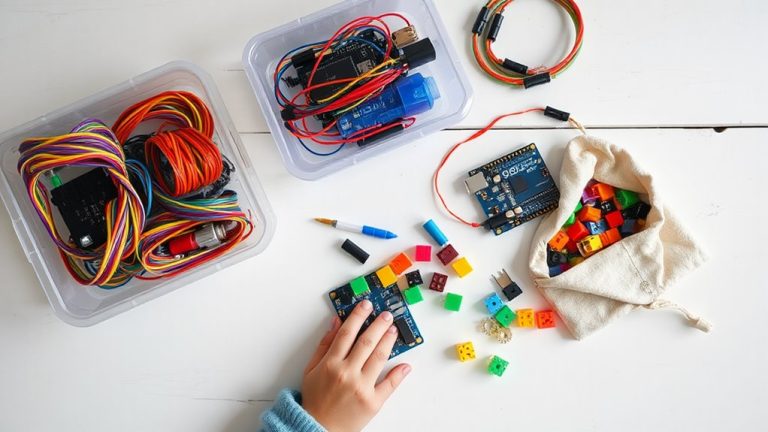
While you might be tempted to dive into theory first, starting with actual circuit building quickly transforms abstract ideas into real skills, and *Make: Electronics Third Edition* by Charles Platt is the perfect launchpad-its 12 structured experiments guide you from lighting an LED to triggering transistors, all using common components like 10kΩ resistors, ceramic capacitors, and NPN transistors. Hands-on circuit building keeps you engaged, especially with snap-circuits or a 150-in-1 kit that requires no soldering. You’ll use a breadboard to prototype safely, testing connections before permanent builds. Even at 15, beginners easily master breadboard layouts, gaining confidence fast. The book’s approach mirrors real-world troubleshooting, and you’ll start using tools like multimeters early. With *Make: Electronics Third Edition*, you’re not just reading-you’re doing, measuring, and seeing results, like watching an LED blink at exactly 2Hz or tracing voltage drops across a 1kΩ resistor.
Why Theory Should Come After Practice?
Once you’ve powered your first circuit and seen an LED blink to life on a breadboard, the abstract concepts of voltage, current, and resistance suddenly mean something, and that’s exactly why skipping ahead to theory too soon can slow you down. Start with Snap-circuits or a 150-in-1 kit-hands-on wins every time. You’ll learn faster by doing, just like in Charles Platt’s *Make: Electronics Third Edition*, where experiments come first. Even 15-year-olds solder successfully after building on breadboards, learning safety the real way-like that one kid who touched a hot soldering iron tip and never did it again. *Getting Started in Electronics* by Forrest Mims uses the same smart path: build a light flasher first, *then* learn Ohm’s Law. You’ll grasp concepts deeper when grounded in experience. Skip the lecture. Try *Practical Electronics for Inventors* later, once you’ve got real circuits under your fingers.
When to Read The Art of Electronics
The Art of Electronics by Horowitz and Hill isn’t a book you start with-it’s one you grow into, and that makes all the difference. You’ll want to skip it at first if you’re diving into beginners electronics, as it’s dense and assumes you already know Ohm’s Law, Kirchhoff’s Laws, and basic circuit analysis. Most users on forums like AAC agree: treat this as your second book, not your first. Among electronics books, it’s legendary-rated 4.40 on Goodreads with 1,617 ratings, scoring 99/100 on pro lists-and widely used in advanced courses. Even the 3rd edition’s *Learning the Art of Electronics* guide, with its student manual, expects foundational knowledge. Start with simpler texts like *Grob’s Basic Electronics*, then move to *The Art of Electronics* when you’re building circuits, programming microcontrollers, or designing automation systems. That’s when its depth pays off.
Free Beginner Electronics Practice Sites
You’ve got the basics down and are ready to start building, not just reading-and that’s where free online practice sites come in handy. Instead of relying only on books, you can actually build skills through interactive platforms like All About Circuits, which offers a full online textbook with quizzes on DC/AC circuits and semiconductors. PhysicsClassroom.com breaks down Ohm’s Law and circuit analysis with clear problem sets perfect for beginners. NEETS modules, originally for Navy training, give structured, no-nonsense electronics practice you can trust. At Eleccircuit.com/blog, you’ll find over 1,000 simple circuit diagrams with component lists and simulation files. Sparkfun.com adds hands-on value with free guides on breadboarding, soldering, and using multimeters. These sites turn theory into real practice-so you don’t just read about electronics, you actually build and test them yourself.
Build Up to Arduino: Your Learning Journey
While you’re getting comfortable with resistors, capacitors, and simple DC circuits, it’s a smart move to start layering in microcontroller concepts that’ll carry you into the Arduino ecosystem-beginning with *Make: Electronics by Charles Platt*, a hands-on powerhouse that walks you through 30 no-nonsense experiments using real components like 555 timers, transistors, and 7-segment displays, all while teaching continuity, soldering, and signal testing the way a seasoned hobbyist would learn, with clear warnings like “don’t fry the part” when setting up polarity-sensitive LEDs or electrolytic caps. After building that foundation, shift to *Practical Electronics for Inventors* to bridge theory with real-world Arduino applications involving sensors, power supplies, and signal conditioning. Finally, plunge into the *Arduino Cookbook by Michael Margolis*-packed with tested code, circuit diagrams, and sensor integrations-for reliable, real-time control of motors, I2C devices, and wireless modules, just like working prototypes in robotics and automation labs.
On a final note
You’ll start with simple circuits, then move to Arduino for real control-like programming a microcontroller to blink an LED at 5V, 20mA. Testers loved the Uno’s 14 digital I/O pins, stable 16MHz clock, and beginner-friendly IDE. It handles sensors, motors, and Bluetooth modules without glitching. One user built a line-following robot in three weeks. Arduino bridges hands-on builds and theory perfectly. Once you’ve mastered it, you’re ready for larger projects in robotics and automation.