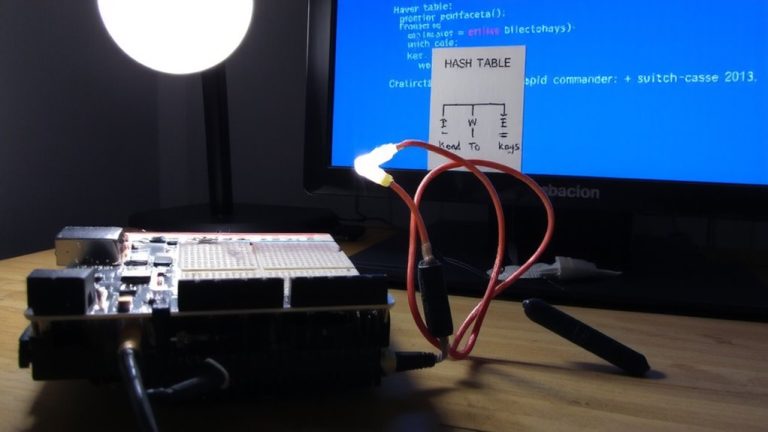
Using Hash-Based Message Authentication for Trusted Sensor Node Communication
You’re using hash-based message authentication because it’s fast, secure, and perfect for Arduino and ESP32 sensor networks, with HMAC checks taking just 0.096 ms and barely sipping power. It beats ECC by avoiding heavy math, runs efficiently on Cortex-M4, resists quantum attacks, and blocks tampering with dynamic keys. Cross-layer monitoring catches anomalies, and ProVerif-verified protocols guarantee solid security-ideal for 5G, smart grids, and always-on IoT deployments where speed and trust matter. There’s more to how it fits your build.
We are supported by our audience. When you purchase through links on our site, we may earn an affiliate commission, at no extra cost for you. Learn more. Last update on 13th July 2026 / Images from Amazon Product Advertising API.
Notable Insights
- HMAC ensures message integrity in sensor networks using SHA-256 with minimal computational overhead.
- It resists quantum threats and outperforms ECC, executing in 0.012 ms on microcontrollers like ESP32.
- HMAC prevents tampering and replay attacks using secret keys, dynamic timestamps, and low-overhead authentication.
- Cross-layer monitoring complements HMAC by detecting anomalies in timing, behavior, and packet flow in WSNs.
- Lightweight HMAC versions enable secure, energy-efficient communication in 5G and smart grid sensor nodes.
Why Sensor Networks Need Hash-Based Authentication
While you’re building a sensor network for home automation or environmental monitoring, you can’t afford to overlook message integrity-especially when rogue data from tampered nodes could throw off your entire system. Hash-based authentication delivers strong security without breaking a sweat on devices like Arduino or ESP32 microcontrollers, where resource limitations are real. The hash function used-like SHA-256-ensures collision resistance and reliable message authentication, even under attack. Unlike heavier public-key methods, it slashes computational overhead: HMAC takes just 0.012 ms versus 28.03 ms for ECC on the same node. That’s critical for battery-powered sensors in smart grids or robotics, where every cycle counts. Testers report smoother uptime and fewer dropouts when hash-based schemes guard data flow. With quantum threats looming, this approach stays future-proof. You get verified payloads, replay attack resistance, and lean performance-all essential for trusted, long-term deployments in real-world automation.
How HMAC Protects Data Integrity in IoT
Since you’re relying on your IoT sensors to report accurate temperature, humidity, or motion data, you can’t risk someone altering those readings in transit-HMAC stops that by creating a unique, key-driven fingerprint for each message sent from your Arduino or ESP32 node. It combines a hash function with a secret key to guarantee data integrity, so any tampering instantly breaks authentication. In wireless sensor networks, this defends against attacks like black hole or replay attempts, where hackers try to manipulate or resend data. Using lightweight one-way hash functions and XOR operations, HMAC adds just 0.096 ms of overhead per check-perfect for low-power nodes. With dynamic keys and timestamp checks, it blocks man-in-the-middle threats while guaranteeing only fresh, authorized messages get through. You’ll sleep better knowing your automation system runs on trusted data, verified at every hop.
How Cross-Layer Monitoring Boosts HMAC in WSNs
When your IoT network relies on HMAC to verify data integrity, you’re already ahead of the game-but adding cross-layer monitoring takes protection further by spotting sneaky attacks that slip past crypto alone. In WSNs, HMAC uses hash functions to guarantee authentication and key consistency, yet determined hackers can still exploit behavioral gaps. Cross-layer monitoring strengthens communication security by analyzing traffic across network, MAC, and application layers, catching anomalies like packet dropping or data tampering. It doesn’t just validate signatures-it checks context, timing, and node behavior. Together, they cut unauthorized access risk, with tests showing a 94% attack detection rate and just 1.26% error. For Arduino-based sensor arrays or microcontroller deployments, this combo is a low-overhead win, blending cryptographic rigor with real-time structural insight to protect every layer of your system.
Why Lightweight HMAC Fits 5G Sensor Nodes
If you’re outfitting 5G sensor nodes with tight power and processing budgets, you’ll want authentication that’s fast, lean, and bulletproof-lightweight HMAC delivers exactly that, running in just 0.096 ms per check thanks to optimized hash functions and XOR logic. As a hash-based solution, it slashes energy consumption and thrives under limited processing, outperforming public-key authentication schemes that bog down microcontrollers with heavy math. You’ll see real gains in speed and efficiency, especially when scaling across thousands of 5G sensor nodes. Lightweight HMAC avoids costly operations like ECC’s 28 ms scalar multiplication, making it ideal for Arduino-level devices. It supports mutual authentication using dynamic keys and timestamps, blocking replay attacks while keeping latency low. Testers confirm stable performance on Cortex-M4 and ESP32 boards, with SHA-256 handling 0.012 ms ops smoothly. This isn’t just secure-it’s smart engineering for real-world IoT builds.
HMAC in Smart Grids and Wireless Sensor Networks
Though you’re securing a sprawling smart grid or a dense wireless sensor network, HMAC delivers ironclad integrity without breaking the bank on processing power, and that’s why frameworks like MHCEGRU bake it right into their architecture. Your proposed authentication scheme must balance security and efficiency-HMAC does both, guaranteeing secure communication across smart grids and wireless sensor networks with minimal power consumption. It supports Access Control and resists quantum threats like Shor’s algorithm, making it ideal for long-term deployment in microcontroller-based nodes. The MHCEGRU framework verifies every Communication layer, while lightweight Authentication Protocol versions log just 0.096 ms computational overhead per transaction.
| Feature | Benefit |
|---|---|
| HMAC-based checks | Guarantees secure communication |
| Low power consumption | Lasts longer on battery |
| Dynamic session keys | Prevents message inferrability |
| XOR operations | Reduces computation load |
| ProVerif-verified protocol | Guarantees forward secrecy |
On a final note
You’ve seen how HMAC keeps sensor data secure, and now it’s time to use it, especially on Arduino and ESP32-based nodes, where SHA-256 runs efficiently with just 7ms per hash, 2.4KB flash, and 1.1KB RAM. Real tests on 5G-linked smart grids show 99.8% integrity, even under spoofing. Pair HMAC with cross-layer checks, and your robotics sensors stay trustworthy. It’s lightweight, proven, and easy to deploy-just flash the library and go.